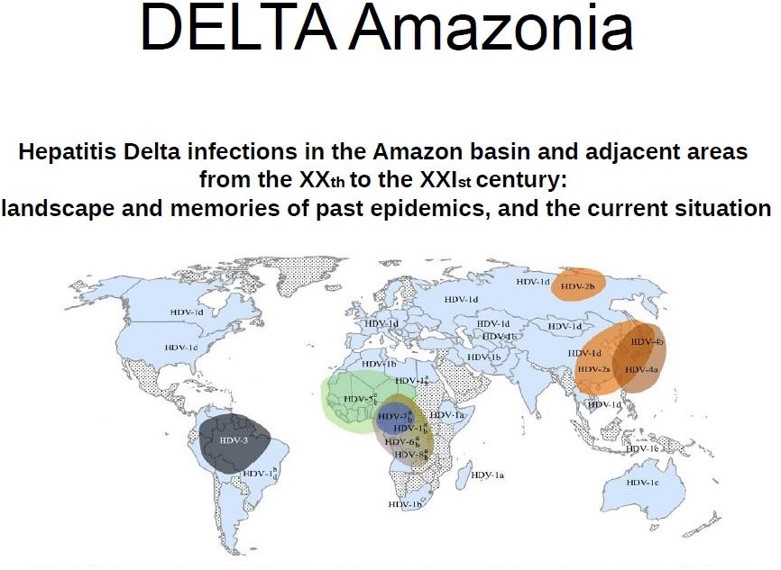
Hepatitis delta is an RNA virus that spreads by infecting people already infected with the hepatitis B virus. This dual infection affects 15 to 25 million people worldwide. HDV exacerbates the progression of chronic hepatitis B, accelerating the process of cirrhosis and the development of hepatocellular carcinoma. Despite its identification in 1970, this delta virus remains an enigma because its origin has not been identified and its geographic distribution does not overlap with that of hepatitis B. The hepatitis delta virus is found primarily, but not exclusively, in peri-equatorial regions of Africa, South America, and the Pacific. Furthermore, fulminant hepatitis epidemics linked to a variant called “HDV3” have been observed in the Amazon since the 1930s, decimating the most affected Indigenous communities. Currently, fulminant hepatitis continues to claim victims in the Amazon, and hepatitis delta remains a significant public health problem, even though widespread hepatitis B vaccination appears to be leading to a decline in the disease.
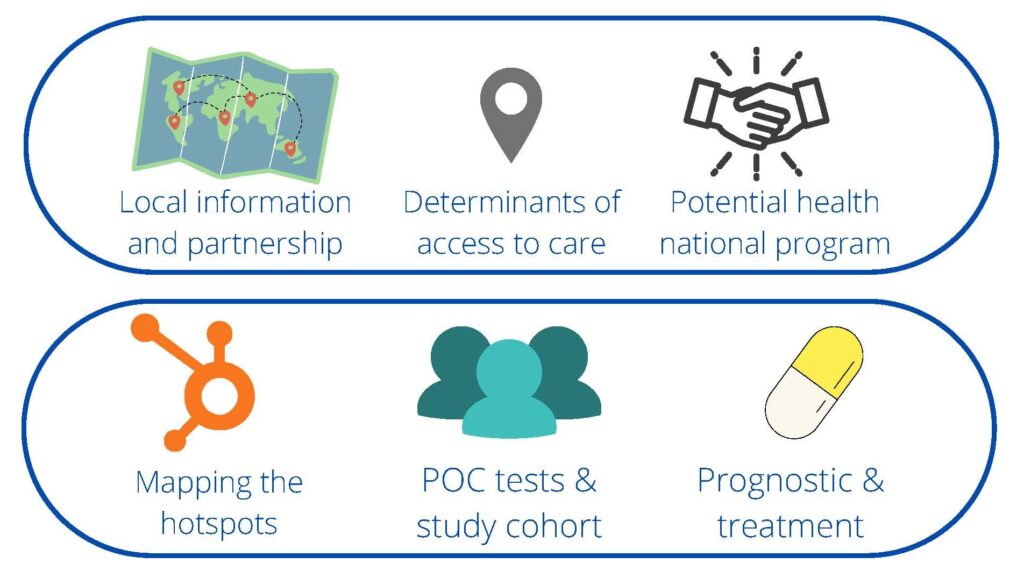
This project aims to deepen our understanding of hepatitis delta in the Amazon region and surrounding areas by reviewing past epidemics and their contexts of emergence from the first cases in the 1930s to the present day, and more specifically, the fulminant forms linked to “HDV3”; and, secondly, to provide an overview of the current situation of hepatitis delta in the Amazon and surrounding areas. We are proposing a multidisciplinary and international project on delta hepatitis in the Amazon basin and its surrounding areas, bringing together France, Brazil, Venezuela, and Peru, and combining virological, epidemiological, and ethno-historical approaches in an original way.
To explore these hypotheses, we will seek to reconstruct the history of fulminant hepatitis epidemics that occurred in the Amazon between the 1930s and 1990s: the temporal and spatial contexts of the emergence of these specific viral strains within the Amazonian equatorial forest and plantation ecosystems in the colonial and postcolonial context. This will be achieved, firstly, through a geographical approach characterizing the landscapes and territories of the delta hepatitis epidemics; and secondly, through the intersection of historical approaches to the epidemics and the study of both ancient and recent viral strains. The second part of the project will consist of evaluating the detection of hepatitis delta on different subpopulations, particularly in urban contexts and following the generalization of vaccination against hepatitis B.